
Let me describe a scene I’ve witnessed at least two dozen times in the last year alone.
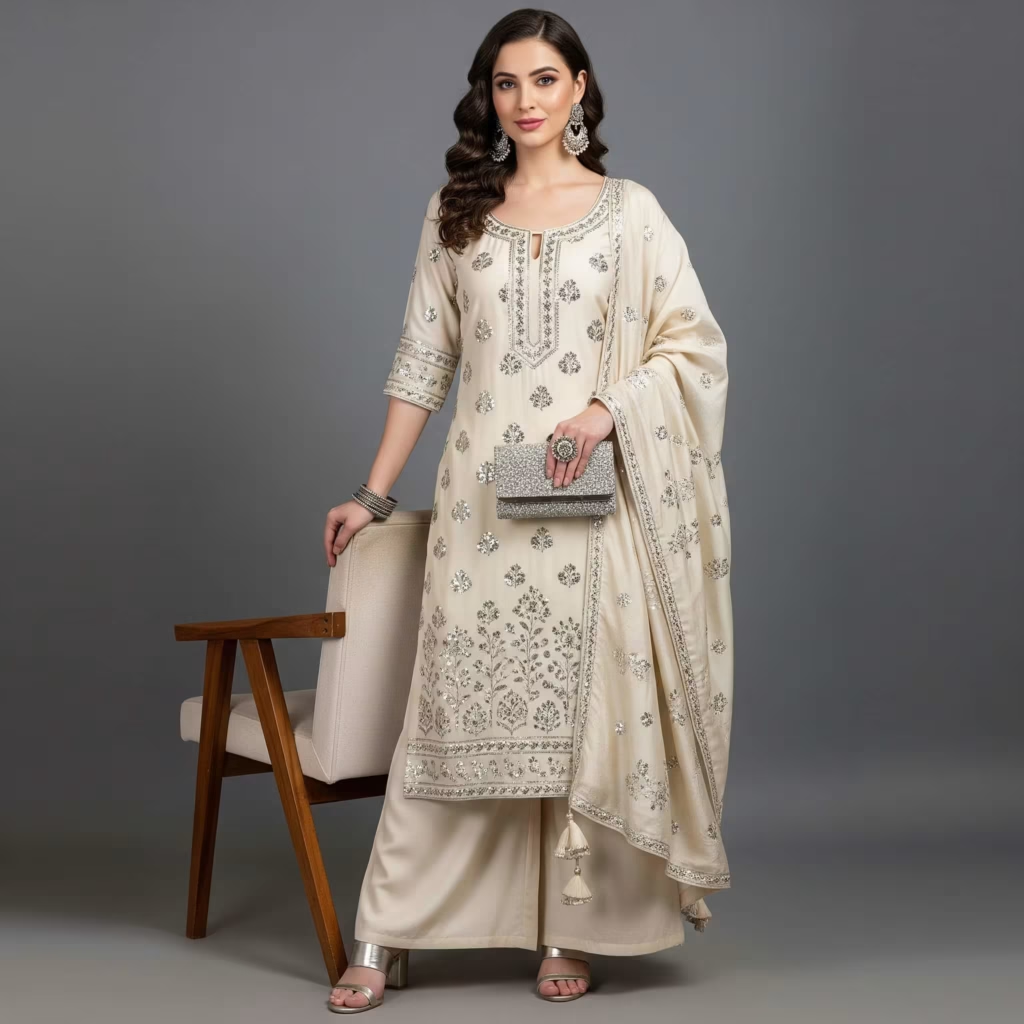
A woman stands in a trial room, turned sideways to the mirror. She’s wearing a breathtaking Anarkali—deep maroon with antique gold embroidery, the kind of kurta that makes salespeople gasp when it’s unboxed. The fabric is luxurious. The craftsmanship is impeccable. The price tag made her wince, but she paid it because this was for that event—the one where she needs to feel unstoppable.
But something is wrong.
She can’t name it. The kurta fits—her arms move freely, the neckline sits correctly, the sleeves are the right length. Yet her reflection whispers that she looks… swallowed. The beautiful silhouette she imagined—regal, flowing, goddess-like—has become something else entirely. She looks shorter. Wider. Lost in fabric that was supposed to make her shine.
She blames herself. “Maybe Anarkalis aren’t for my body type.” She hangs it back, walks out, and settles for something safe.
Here’s what she didn’t know: the problem wasn’t her body. It wasn’t even the Anarkali. It was the relationship between the two—a relationship governed by something most of us never consider.
Geometry.
The Hidden Architecture of the Perfect Anarkali
Every Anarkali is a mathematical statement dressed in fabric. Before it’s embroidery, before it’s color, before it’s tradition or trend, it’s a series of measurements interacting with another series of measurements—yours.
Think of it this way: an Anarkali is essentially a dome resting on a column. The dome is the flared portion, starting somewhere around your waist or hips and expanding outward. The column is you—your body from the flare point upward. The visual success of the entire structure depends on one thing: proportion.
When architects design domes, they don’t just guess. They calculate ratios—the height of the dome relative to the diameter of the base, the curve’s radius, the transition point where vertical meets horizontal. The same mathematics applies to your kurta, except most of us are flying blind.
I learned this the hard way, watching my own mother order an Anarkali online that looked stunning on the model. When it arrived, she put it on and disappeared. The kurta wore her, not the other way around. We returned it, both of us frustrated, neither understanding why.
It took two years of watching hundreds of women try on thousands of Anarkalis to finally crack the code. The answer was hiding in plain sight: length.
The Three Numbers That Control Everything
Forget sleeve style. Forget neckline depth. Forget everything you think matters about an Anarkali. Three numbers determine whether you’ll look regal or ridiculous, and none of them are the ones you’re checking.
Number One: Your Waist-to-Floor Measurement
Stand barefoot against a wall. Have someone mark the spot where your natural waist bends—not where you wear your jeans, but the narrowest part of your torso when you lean sideways. Measure from that point straight down to the floor.
This number is sacred. It’s the foundation of every great Anarkali you’ve ever admired, whether you knew it or not.
Number Two: The Flare Start Point
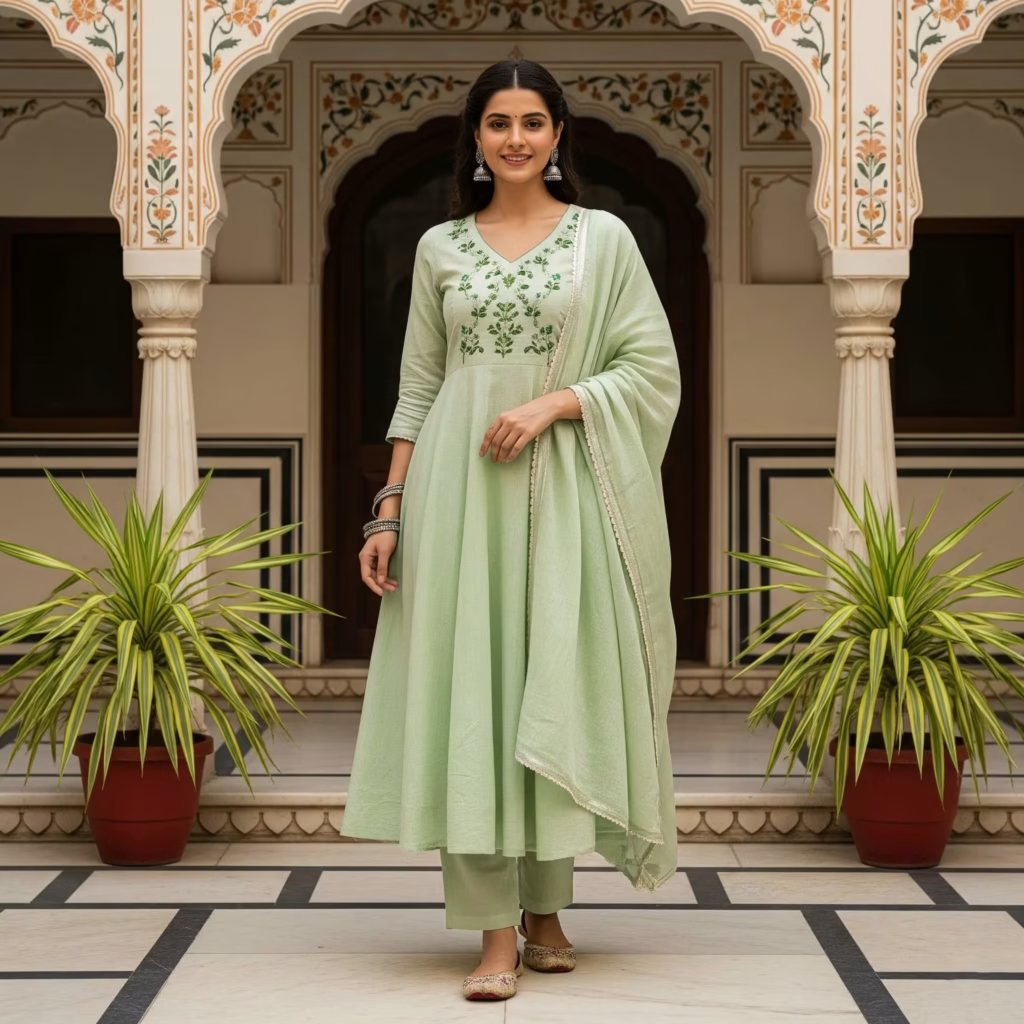
Here’s where things get interesting. Anarkalis don’t all begin flaring at the same place. Some start just below the bust (the “empire” cut). Some at the natural waist. Some at the hips. Some at the knees.
The distance between your flare start point and the floor determines everything about how you’ll look. Too short a distance, and you’ll look like you’re wearing a bell. Too long, and you’ll look like you’re drowning in fabric.
Number Three: The Flare Radius
This is the curve’s aggression—how sharply the fabric moves away from your body. A gentle flare creates a soft A-line. An aggressive flare creates that dramatic, lehenga-like volume. The right choice depends entirely on your height and build.
Most women pick an Anarkali based on photos, not physics. They see a beautiful garment on a model who’s 5’9″ with proportions completely different from theirs, and they assume the magic will transfer. It won’t. Magic doesn’t transfer—it translates. And translation requires understanding the original language.
What Your Reflection Is Trying to Tell You
Let me walk you through what happens when these numbers misalign.
Scenario A: The Kurta Is Too Long for Your Torso
You put it on, and something feels heavy. The flare starts too low—maybe at your hips when it should start at your waist. The fabric gathers around your thighs, creating width exactly where you don’t want it. Your upper body looks compressed, your lower body looks expanded, and the overall effect is… solid. Grounded. The opposite of the floating, ethereal look you wanted.
This is the most common mistake in Anarkali shopping, and it has nothing to do with weight or height. It’s purely about proportion. The flare point is misaligned with your body’s natural geometry.
Scenario B: The Kurta Is Too Short for Your Legs
You’re taller than average, and you’ve learned to make peace with sleeves being too short and hems riding high. But an Anarkali that ends above your ankle bone creates a visual chop—your legs appear to start at the hem, not at your waist. The continuous line from shoulder to floor is broken, and you lose the elongating effect that makes Anarkalis so flattering.
Scenario C: The Flare Is Wrong for Your Frame
You’re petite, and you’ve chosen a heavily flared Anarkali because you love the drama. But when you wear it, you feel like a child playing dress-up. The volume overwhelms you, and instead of looking like a queen, you look like you’re hiding behind fabric.
You’re not too small for drama. You’re just wearing the wrong drama. A gentler flare that starts higher would give you the same regal feeling without the disappearing act.
The Self-Measurement Trick That Changes Everything
Here’s the simple technique I now share with every woman who asks me about Anarkalis. It takes two minutes, requires no special tools, and has never failed to improve someone’s shopping results.
Step One: Find Your “Sweet Spot”
Stand in front of a full-length mirror in fitted clothing—leggings and a tank top work perfectly. Take a piece of ribbon or a scarf and hold it horizontally against your body at different levels: just under your bust, at your natural waist, at your high hip, at your low hip.
Watch what happens in the mirror. The ribbon creates a visual line. Notice how your perception of your height changes as the ribbon moves. For most women, there’s a point—usually somewhere between the natural waist and high hip—where the line seems to lengthen rather than cut. That’s your sweet spot.
Step Two: Measure From That Point to the Floor
Have someone help, or use a measuring tape against a wall. Write this number down. It’s your personal Anarkali anchor.
Step Three: Compare Before You Buy
When you’re shopping online or in stores, look for the “flare start” information. Many quality brands now include it. If they don’t, estimate by looking at where the gathers begin in the product photos. Compare that to your sweet spot measurement.
The ideal Anarkali has its flare start within two inches of your sweet spot, in either direction. Any further, and you’re gambling with proportion.
The Optical Illusion of Embroidery
There’s a quiet trick that heavily embroidered Anarkalis play on you.
When you see dense threadwork, zari, sequins, or elaborate motifs, your attention goes straight to the craftsmanship. You admire the detailing. You think about the occasion. You imagine the compliments.
What you don’t immediately register is placement.
Embroidery isn’t just decoration—it creates visual weight. And wherever that weight sits, that’s where the eye pauses.
I once watched a woman try on two Anarkalis that were identical in cut but different in embellishment layout. One had concentrated embroidery near the hemline, forming a heavy border. The other had lighter work scattered evenly throughout.
On the hanger, both looked beautiful.
On her body, they told two completely different stories.
The hem-heavy piece pulled attention downward and made her frame appear shorter and grounded. The evenly distributed design allowed the eye to travel vertically, giving her a taller, more fluid silhouette.
The lesson is simple: before you admire the embroidery, study the empty spaces. Notice where the fabric is calm and where it’s busy. That distribution shapes how you are perceived long before anyone registers the details.
Height Isn’t the Whole Story—Proportion Is
You’ve probably heard the common advice: tall women can carry anything; petite women must be cautious. It’s partially true—and mostly unhelpful.
Let’s make it more practical.
If You’re Under 5’4”
Your biggest ally is uninterrupted vertical flow.
Choose Anarkalis where the flare begins at or slightly above your natural waist. This creates a longer visual line from flare to hem, which subtly elongates your frame.
Be mindful of thick borders or heavy embellishment at the bottom—they visually “cut” height. If you want detail, shift it upward: an ornate yoke, statement sleeves, or a detailed neckline keeps attention closer to your face.
If You’re Between 5’4” and 5’7”
You have room to experiment.
Flare can begin at the waist or drift toward the high hip without dramatically altering balance. Play with volume. Try different radii of flare. This is the range where personal style can shine without fighting geometry.
Notice what makes you feel natural—not just what looks dramatic in the mirror.
If You’re Over 5’7”
Your scale needs matching scale.
A flare that starts too high can make proportions feel top-heavy. Look for designs where the flare begins closer to the hip or slightly below. Generous volume complements your height rather than competing with it.
Length is critical. An Anarkali that ends awkwardly above the ankle can feel unfinished. Seek brands offering extended lengths or consider minor tailoring. A little extra fabric can make all the difference.
The Trial Room Reality Check
Before committing to any outfit, pause.
Close your eyes for a moment and picture the event. The lighting. The music. The conversations. Imagine yourself walking in. Notice how the fabric moves.
Now ask: does the version of you in that scene feel authentic?
Not slimmer. Not taller. Not more glamorous. Just… you.
If your mind hesitates, trust that instinct.
Clothes should amplify who you are—not create a costume you have to perform inside.
A Small Adjustment, A Big Shift
A woman I know—let’s call her Radhika—had sworn off Anarkalis altogether. After several purchases that felt “almost right” but never quite satisfying, she concluded the style simply didn’t suit her.
Then at a wedding, she saw her cousin wearing a soft peach Anarkali that seemed effortless. It wasn’t overly embellished. It wasn’t the most expensive outfit in the room. Yet her cousin moved through the celebration with ease—laughing, dancing, completely comfortable.
Curious, Radhika tried it on.
Same height. Similar build. But in the mirror, the magic felt muted.
The difference? Two inches.
Her cousin had subtly adjusted where the flare began. Just enough to hit her personal balance point.
Radhika decided to experiment. She ordered her own Anarkali and had the flare raised slightly to suit her proportions. That festive season, she wore it without second-guessing herself. Not once.
What changed wasn’t her body.
It was alignment.
The Simple Formula
If you strip away trends and decoration, the foundation is this:
The Right Anarkali = Your Natural Balance Point + Proper Flare Placement + Proportional Volume
Everything else—color, embroidery, sleeves, neckline—builds on that structure.
Beautiful details matter. But only after the base is correct.
Your body isn’t the problem to solve. It’s the constant in the equation. The garment is the variable.
When the proportions are right, you stop adjusting, tugging, and checking mirrors. You start enjoying the moment instead.
And that’s the real purpose of dressing well—not to transform into someone else, but to feel more fully yourself.