
There’s a moment that happens in every woman’s life. You’re standing in front of the mirror, saree draped, pins in place, and something feels… off. The mirror doesn’t lie, but it doesn’t explain either. You adjust the pallu. Tug at the pleats. Change the blouse. Nothing works.
Then you do what we all do: smile anyway, walk out, and spend the entire event feeling like you’re wearing someone else’s clothes.
I’ve been that woman. So has my mother. So has every close friend I’ve ever shopped with. And for decades, we accepted this as normal—the price of admission into the world of six yards of unstitched elegance.
But here’s what I’ve learned after spending two years watching women interact with sarees: the problem was never you. It was the distance between how you see yourself and how the saree sees you.
And technology? It’s finally learning to bridge that gap.
The Language Your Saree Speaks (That Nobody Translated Until Now)
Let me tell you about Meera. She’s 41, a lawyer in Mumbai, and she’d worn sarees her entire adult life. She thought she knew what worked: dark colors, heavy borders, traditional drapes. Safe choices.
Then she uploaded her photo to our platform—not for shopping, just curiosity. What came back stopped her cold.
The AI didn’t just look at her skin tone. It analyzed the relationship between her jawline and neck length, the spacing of her features, the way light fell on her face at different angles. And it suggested something she’d never considered: a light mint green Chanderi with a thin silver border. Minimal. Almost boring on the hanger.
She almost deleted the suggestion. But something made her pause—the analysis mentioned that her angular features needed softening, and the sheer fabric would create movement that balanced her stillness.
She ordered it. Wore it to a colleague’s wedding. Her husband, who never notices clothes, asked if it was new. Three people wanted to know her designer. And Meera finally understood something profound: the saree hadn’t changed. Her relationship with it had.
This is what happens when technology stops treating you like a mannequin and starts seeing you as architecture.
The Emotional Mathematics of Getting Dressed
Here’s something nobody tells you about sarees: they’re mathematical.
Every saree has a formula. Border weight + fabric drape + color intensity + motif density + blouse proportion = how you’ll feel walking into a room.
Get one variable wrong, and the equation fails. You’re not understated—you’re invisible. Not bold—overwhelming. Not traditional—dated.
The problem is, we’ve been doing this math in our heads, under pressure, in bad lighting, with salespeople breathing down our necks. And we wonder why we make mistakes.
What if the math could be done for you? Not by another person with their own biases, but by something that’s analyzed 50,000 sarees and 10,000 women’s feedback on how those sarees made them feel?
This is the quiet revolution happening right now. Not in labs or tech conferences, but in bedrooms and trial rooms where women are finally saying: show me what I can’t see myself.
The Invisible Map of Your Body
For years, we’ve been sold a lie about body types. Pear. Apple. Hourglass. These aren’t descriptions—they’re cages. They reduce the complexity of your unique form to a grocery list category.
Your body has its own geography. The slope of your shoulders. The curve of your lower back. The way your hips carry weight. The length between your waist and knee. These aren’t flaws to hide. They’re features to work with.
I watched a woman named Kavya discover this firsthand. She’s 35, postpartum with her second child, and had completely given up on sarees. “Nothing drapes right anymore,” she told me. Her body had changed, and she hadn’t updated her mental map.
We asked her to stand in front of her phone camera in a fitted top and leggings. No special equipment. Just 30 seconds of turning slowly.
The analysis came back with something unexpected: her weight had redistributed in a way that created a beautiful proportion between her upper and lower body that wasn’t there before. The recommendation wasn’t for “slimming” dark colors or vertical prints. It was for medium-weight silks with borders that started below the hip, drawing attention to this new balance.
She cried when she tried the first recommendation. Not because it was emotional—because it was the first time in two years she’d looked in a mirror and seen herself, not just what was different.
The Memory Problem That Haunts Every Wardrobe
Walk into any Indian woman’s home, and you’ll find them: the sarees that live in the back of the cupboard. Worn once. Maybe twice. Too precious to give away, too disconnected from your current self to wear.
They’re not just fabric. They’re frozen moments. Your cousin’s wedding. Your first Diwali as a married woman. The saree your mother picked for your graduation. And they sit there, gathering guilt along with dust.
Technology can’t make you wear them. But it can show you how.
When we built our restyling feature, we expected women to use it for new purchases. Instead, something unexpected happened. They started uploading photos of sarees they already owned—the unworn, the inherited, the “what was I thinking” purchases.
A woman in her fifties uploaded a heavy Kanjeevaram she’d bought for her son’s wedding but never wore again. The system showed her five completely different drapes: a casual half-saree style for Sunday lunches, a belt-drape for dinners out, even a jacket-style fusion look she’d never imagined.
She sent us a photo two weeks later. She’d worn it to a book club meeting. The same saree that had been hanging for three years, suddenly alive again.
This is what good technology does: it doesn’t give you more things. It gives you more life from the things you already have.
The Color Conspiracy You Never Knew Existed
Here’s something the fashion industry won’t tell you: most color advice is designed to sell you more clothes, not to make you look good.
“Wear this season’s color.” “Neutrals are safe.” “Brights make a statement.” These aren’t insights—they’re scripts. And they ignore the most important factor: you.
Skin tone analysis has existed for decades, but it’s been surface-level. Warm, cool, neutral. Pick your lane. But your skin isn’t a single note—it’s a symphony. The surface tone you see in the mirror interacts with undertones that shift with light, with the colors around you, with your emotional state.
I watched a woman named Shreya discover this when she tried our color matching feature. She’d always worn gold jewelry and earth tones—everyone told her she was “warm.” But the AI caught something: in natural light, her skin had a subtle pink undertone that made warm yellows look jarring. It suggested a rust color with blue undertones—technically warm, but with enough cool influence to harmonize.
She’d never considered such a color. It became her most-complimented saree.
The conspiracy isn’t that bad advice exists. It’s that we’ve accepted generic advice as good enough. And in a world where AI can analyze millions of color combinations against millions of skin variations, “good enough” is no longer acceptable.
The Fabric Lie We All Believe
Touch a Tussar silk. Now imagine it draped. Different, right?
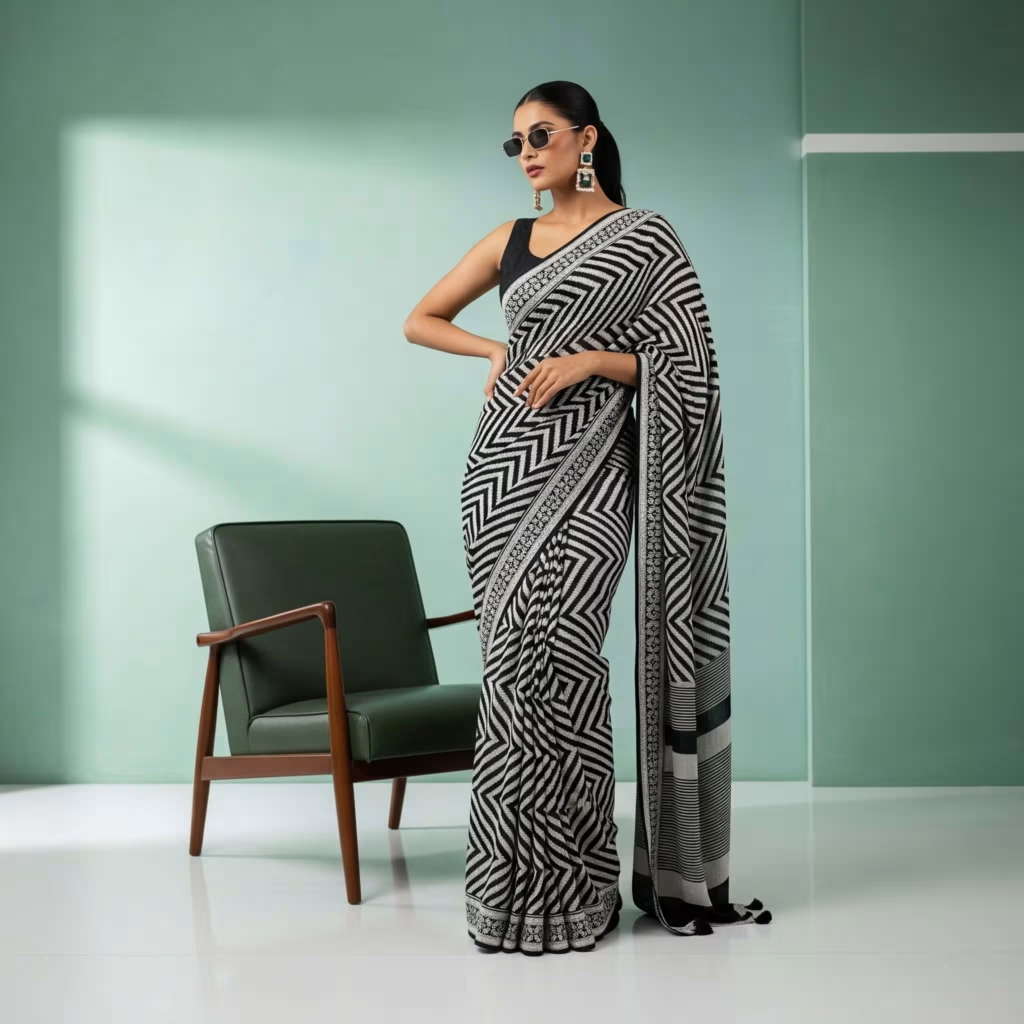
This is the biggest lie in online shopping: that fabric behaves the way you imagine it will. It doesn’t. It has its own personality, its own stubbornness, its own way of moving with or against your body.
I learned this the hard way with a beautiful Maheshwari that looked fluid in photos but stood away from my body like cardboard when I wore it. The fabric was right. The expectation was wrong.
This is why fabric simulation matters more than any other technology we’ve built. When you can see how a fabric falls, gathers, and moves before you buy it, you’re not just buying a photo. You’re buying a prediction.
A woman in Chennai used our drape simulator to compare two almost-identical Kanjeevarams—same color, same border, same price. But the simulation showed one falling in soft folds while the other held stiff pleats. She wanted soft. She ordered the right one.
That’s not shopping. That’s certainty.
The Algorithm of Memory
There’s a question we ask every woman who uses our platform: what’s your earliest saree memory?
The answers are surprisingly consistent. A mother getting ready for a wedding. A grandmother’s hands pleating fabric. The smell of naphthalene balls and old silk. The sound of bangles against a dressing table.
We ask because we’ve learned something important: your relationship with sarees isn’t just about now. It’s about then. The little girl watching, learning, absorbing what beauty looked like in her world.
Good technology doesn’t erase those memories. It builds on them. When our system suggests a saree, it’s not just matching colors and body types. It’s matching the story you’re still writing.
A woman in her sixties told us she wanted something “modern” but felt lost in current trends. We asked her to describe her mother’s favorite saree. She did—a simple cotton with a unusual orange border, nothing fancy, but her mother had worn it with such confidence. Our search found a contemporary version: a linen saree with the same orange accent, modern fabric, traditional memory.
She bought it. Wore it to her granddaughter’s naming ceremony. Her daughter-in-law asked where she got such a unique piece. “From my mother,” she said. And meant it.
The Question You Should Ask Before Every Purchase
Before you buy your next saree, stop. Don’t look at the price. Don’t check if it’s in stock. Ask yourself one question:
Will I remember buying this five years from now?
If the answer is no, put it back. If the answer is yes, you’ve found something real.
Because the best sarees aren’t the ones that get compliments at one event. They’re the ones that become part of your personal mythology. The blue you wore when you got your promotion. The red that made you brave during a difficult year. The white that felt like starting over.
Technology can help you find these sarees. It can analyze, predict, simulate, and suggest. But it can’t feel for you. That part remains yours—the flutter in your chest when you see something that speaks to who you are, or who you want to become.
We built our tools to remove the noise, not the feeling. To eliminate the guesswork, not the magic. To help you trust yourself more, not less.
What Comes Next
The future of sarees isn’t about algorithms replacing human judgment. It’s about algorithms doing the boring work so you can do the beautiful work.
Let the technology figure out whether a particular green washes you out. Let it calculate whether a border will hit you at the right spot. Let it simulate how a fabric will move when you dance at your best friend’s wedding.
You focus on the rest. The way the fabric feels between your fingers. The memory it stirs. The person you become when you wear it.
Because that person—the one who walks into a room and knows, deep in her bones, that she belongs there—she was always there. She just needed the right six yards to come out and play.